
Enhancing Financial Empowerment and Innovation for Women in Moyamba and Freetown.
While 74% of women worldwide are considered financially included, Sierra Leone has one of the lowest financial inclusion rates for women at only 25% (the World Bank’s Global Findex 2021, report). The situation is even more stark for marginalised young women, including those with disabilities, those affected by sexual and gender-based violence (SGBV), and those living in rural communities or informal settlements.
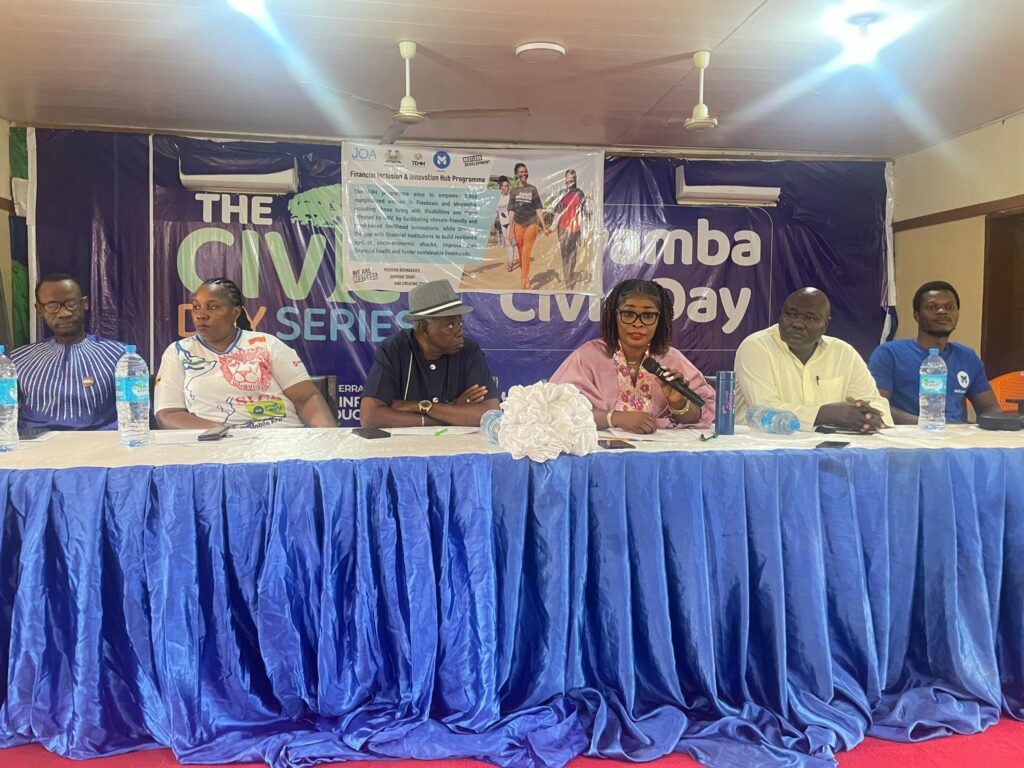
By 2028, the FIIH programme will improve financial wellbeing for 5,000 marginalised women, including 150 women with disabilities, across 15 urban informal settlements in Freetown and 25 rural and peri-urban communities in Moyamba. These women will be empowered to be more independent and to make positive decisions about their lives and households.
THREE CORE COMPONENTS OF THE PROJECT:
INCLUSION: In response to the identified barriers to financial inclusion for marginalised women in Sierra Leone, including collateral requirements, high-interest rates, stigma, and harmful gender norms, the programme focuses on tackling these obstacles so that women can actively participate in formal financial processes. This would be achieved through targeted training, awareness-raising, and community engagement, complemented by institutional engagement to promote better disability inclusion.
INNOVATION: Addressing barriers to women-led livelihoods in Moyamba and Freetown, including limited access to formal financial services, technology and capacity gaps, and energy insecurity. The project adopted an innovative ecosystems approach to provide women entrepreneurs with innovative financial products, skilling, technology support, forward and backward linkages and institutional engagement. 20 Decentralized Renewable Energy (DRE)-powered livelihood pilots will enable income-generating opportunities for marginalised women, using contextually relevant financial and business models informed by youth-led research to further replicate and scale.
INSTITUTIONALISATION: Recognising the need to address the disconnect and mistrust between communities and financial institutions. FIIH will engage financial institutions and government stakeholders to ensure they are responsive to the financial needs of marginalised women and their communities. The programme will build inclusive narratives, mobilise community-driven advocacy, and institutionalise systemic practices at the national level to further scale financial inclusion for marginalized women at the regional and national levels.
I was ashamed to speak out or do basic banking because I couldn’t read or write. But with the Financial Inclusion project, I now have a bank account, have received and paid two sets of loans from the women’s banking service introduced by Restless Development, I have established my dream business & can speak boldly.
Bondu Kamara, Community Woman.

